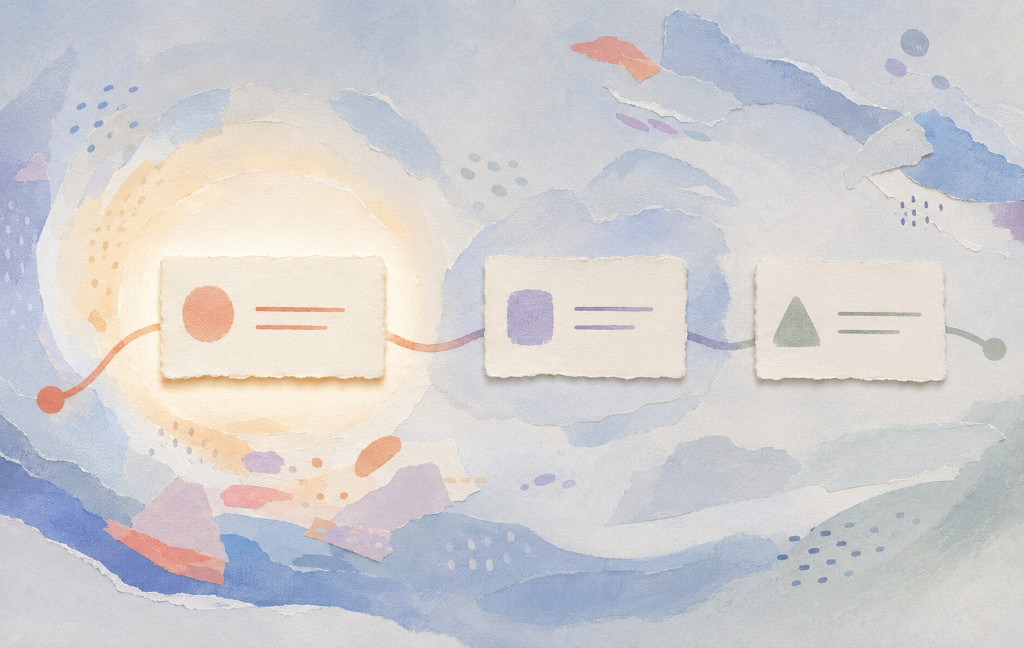
The aim is not to remove everything from the main list. It is to stop every task from competing for attention at the same time.
The process is simple:
Choose three tasks.
Focus on one.
Finish the day clearly.
Choose three tasks for today
Look at the full list and choose three things that would make the day feel meaningful and realistic.
Not three projects or categories. Three clear actions that can move forward today.
A useful combination might include:
-
One important task
Something that moves a project or goal forward. -
One necessary task
Something that keeps work or daily life running. -
One smaller task
Something useful that can realistically be completed.
For example:
- Finish the first draft of the presentation.
- Book the dentist appointment.
- Walk for 30 minutes.
The other tasks have not disappeared. They are simply not allowed to compete for attention today.
Make each task easy to start
Vague tasks create more decisions.
“Work on portfolio” does not explain where to begin.
“Write the case study introduction” does.
“Exercise” leaves many options open.
“Walk outside for 30 minutes” gives a clear instruction.
A useful daily task usually begins with an action:
- Write the first paragraph
- Send the revised file
- Call the dentist
- Review five pages
- Walk for 30 minutes
If a task still feels too large, make it smaller.
Today’s task does not need to finish the entire project. It only needs to move it forward.
Focus on one task at a time
Choosing three tasks reduces the number of decisions in the day. Focusing on one reduces them even further.
Researcher Sophie Leroy uses the term attention residue to explain what can happen when people switch between tasks. Part of their attention may remain with the previous task instead of fully moving to the new one.
It is like leaving several browser tabs open in the mind.
Whenever possible, keep one task visible and let the other two wait.
Finish it, divide it into a smaller step, or make a conscious decision to stop. Then move forward.
Do not turn three tasks into another rule to fail
Some days, all three tasks will be completed.
Some days, only two.
On a difficult day, completing one meaningful task may be enough.
The three-task approach is not about building a perfect record. It gives the day a clear direction without pretending that every responsibility can be completed at once.
The goal is not to finish everything.
It is to finish the day knowing that attention was given to something that mattered.
What happens to the other tasks?
They stay on the main list.
Tomorrow brings another chance to review them and choose again.
Some will become important. Others will wait. A few may eventually reveal that they were never important enough to do.
A task does not automatically deserve time because it was added to a list.
The list can hold possibilities.
The day cannot.
Less planning. More doing.
This is the idea behind Tody.
Tody is a daily execution app, not another place to manage an endless list. It helps users choose three tasks for today and focus on them one by one.
No complicated system. No need to organize every part of life.
Choose three. Focus on one. Finish the day clearly.
Because a useful to-do list should not only remember what needs to be done.
It should help turn a decision into action.